

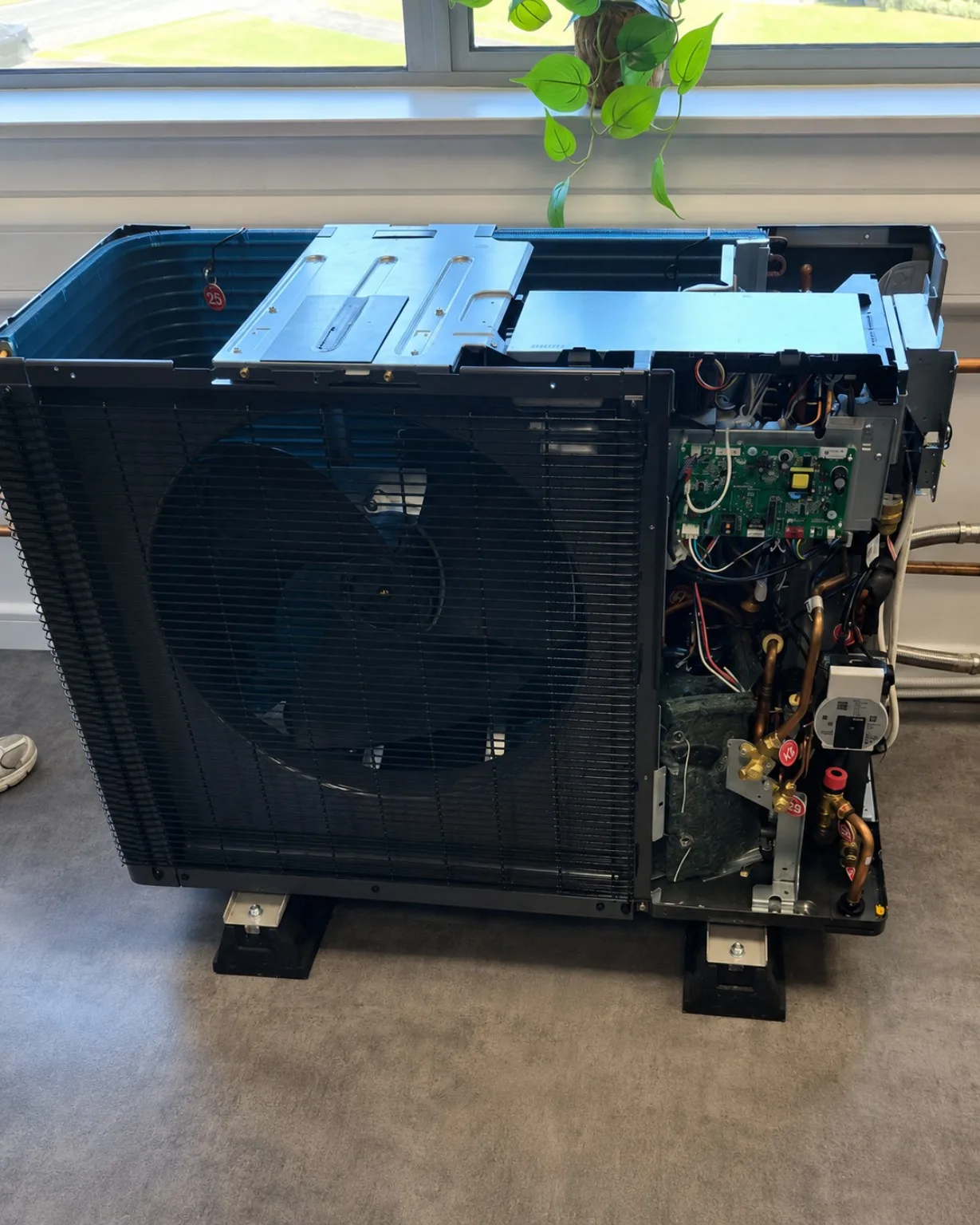
I get asked quite a lot now whether heat pumps are better than boilers, especially with everything in the news about gas heating, renewables and future changes in Scotland.
The simple answer is: it depends.
A heat pump can be a great option for the right house, but that does not mean a boiler is suddenly the wrong choice. The two systems do the same basic job, but they go about it in very different ways.
So here’s my take on the main differences, what stays the same and what you should think about before deciding.
First of all, they both have the same job
Whether you have a boiler or a heat pump, the aim is the same.
Your house is losing heat all the time, especially through walls, windows, doors, floors and the roof. Your heating system has to replace that heat and keep the house comfortable.
In most homes, both boilers and air source heat pumps can use a wet central heating system, so you are still talking about pipework, radiators, underfloor heating, controls and pumps.
It is the way the heat is produced that changes.
How a boiler works
A gas boiler is pretty straightforward. It burns gas, creates heat and transfers that heat into the water running around your heating system.
That hot water then goes through your radiators or underfloor heating. If you have a combi boiler, it also heats your hot water when you turn on a tap.
It is a system most of us are familiar with and it works well when it is installed and maintained properly.
A heat pump is different
A heat pump does not burn fuel at the appliance. Instead, it takes heat that is already outside and moves it into your home.
An air source heat pump uses heat from the outside air, even when it feels cold outside, and raises the temperature using a refrigeration cycle. It then transfers that heat into your heating system.
Because it is moving heat rather than producing all of the heat directly from electricity, a heat pump can deliver several units of heat for each unit of electricity it uses.
The biggest difference is temperature
This is probably one of the most important things to understand.
A traditional boiler system can run at fairly high temperatures. Heat pumps usually work best at lower temperatures.
For example, a boiler might traditionally have been running your radiators at 60 or 70 degrees. A heat pump system might be designed around a much lower flow temperature, often around 40 to 45 degrees depending on the property and system design.
That does not mean your house will be cold. It means the heating system needs to be designed differently.
Instead of very hot radiators for short periods, a heat pump is generally happier running at lower temperatures for longer and keeping the house at a steadier temperature. Energy Saving Trust guidance also explains that lowering heat pump flow temperatures can improve efficiency.
What about the radiators?
This is where people sometimes assume a heat pump means replacing every radiator in the house.
Not necessarily.
Some existing radiators might be absolutely fine. Others might need to be bigger.
The reason is simple. A radiator gives out less heat when the water flowing through it is cooler.
So if you are moving from a boiler running at a higher temperature to a heat pump running at a lower temperature, you need to check that each radiator can still provide enough heat for the room.
This is why room by room heat loss calculations are so important. You are not just choosing a heat pump based on the size of the house. You need to know how much heat each room actually needs.
This is where proper design matters
With a boiler replacement, it is quite common for people to think along the lines of, “I’ve got a 30kW boiler now, so I’ll fit another 30kW boiler.”
That is not really how a heat pump should be approached.
You need to look at the property properly, including room sizes, insulation, windows and doors, heat loss, radiator sizes, pipework, hot water demand, flow temperatures and controls.
A well designed heat pump can work very well. A badly designed heat pump can be expensive to run and frustrating to live with.
And to be fair, the same principle applies to boilers too. Poor design is poor design, whatever appliance is producing the heat.
What about hot water?
This is another noticeable difference.
A lot of homes in Scotland have combi boilers. With a combi, you turn the tap on and the boiler heats the water as you use it.
Most air to water heat pump installations use a hot water cylinder instead, so you need space for one. That can be an important consideration, especially if you live in a smaller house or flat.
Will a heat pump actually work in Scotland?
Yes.
This comes up all the time. People hear “air source heat pump” and think, “It’s freezing outside in winter, how can it get heat from the air?”
There is still heat energy in the outside air when the temperature drops below zero, and the heat pump is designed to extract it.
The important part is that the system is designed for the temperatures we actually experience in Scotland. That is why proper heat loss calculations matter.
A heat pump fitted to a modern, well insulated house is one thing. A heat pump fitted to a large, older stone house is another. That does not automatically mean the older house cannot have one. It means the design has to suit the building.
Does your house need to be perfectly insulated?
No. That is another common misunderstanding.
You do not need to live in a brand new house for a heat pump to work, but insulation does matter.
The more heat your house loses, the more heat your heating system has to put back in. That applies whether you have a boiler or a heat pump.
So if there are sensible insulation improvements available, they can usually help whichever heating system you choose.
What about efficiency?
This is where the numbers can get confusing because boilers and heat pumps are measured differently.
A boiler is taking fuel and turning it into heat. A heat pump is using electricity to move heat from outside into your home.
Heat pumps are usually talked about in terms of COP or SCOP. If a heat pump has a COP of 3, for example, it means it is producing roughly three units of heat for every unit of electricity being used under those particular conditions.
That number changes depending on the outside temperature, flow temperature, hot water use, system design, controls and how much heat the property loses.
This is why I would be cautious of anyone promising you a specific saving without actually looking at your house first.
Are heat pumps cheaper to run?
Sometimes yes, sometimes no.
You have to look at the price of gas, the price of electricity, how efficient the current boiler is, how efficiently the heat pump will operate, how warm you keep the house and how the whole system has been designed.
I would never tell every homeowner they are automatically going to save a fortune by switching. It needs to be looked at properly.
Heat pumps normally cost more to install
There is no getting away from that. A heat pump installation will normally involve a bigger upfront investment than a straightforward boiler replacement.
You can also have additional work such as radiator changes, a hot water cylinder, pipework changes, electrical work and controls.
Financial support for clean heating and energy efficiency measures is available to some Scottish homeowners through Home Energy Scotland. The funding and eligibility rules can change, so it is worth checking the current scheme directly before making a decision or starting work.
Are gas boilers being banned?
There has been a lot of confusion around this.
Scotland is moving towards lower carbon heating and the rules for new buildings have already changed. The New Build Heat Standard applies to new buildings and some conversions where the building warrant was applied for on or after 1 April 2024, with the current rules restricting direct emissions heating systems.
That is not the same thing as saying everyone with an existing gas boiler suddenly has to take it out.
If you currently have a boiler in your house, there is a big difference between rules affecting new buildings and rules affecting existing homes. Government policy can change, so it is always worth checking the current position rather than relying on a headline or social media post.
What is actually the same?
Quite a lot.
Both systems still rely on good system design. Depending on the installation, that means properly sized pipework, suitable controls, correctly sized heat emitters, sensible system balancing, clean system water and proper maintenance.
Heat pumps are not maintenance free. They are simply different appliances with different servicing requirements.
A gas boiler also has combustion and gas safety checks that do not apply to a heat pump.
So which one is better?
I don’t think there is a universal answer.
For some people, replacing an existing boiler with another modern boiler will still make complete sense.
For others, a heat pump could be a really good option.
A heat pump might suit you if you are looking to move away from fossil fuels, your property can work well at lower heating temperatures and you are happy to make any changes needed to the rest of the heating system.
A boiler might still suit you if you already have gas, your existing system works well, you want a more straightforward replacement and you are not ready to make a bigger change to the property.
There will also be plenty of houses where either option could work. That is where you need to look at the home, not just the appliance.
The choice is yours
At the end of the day, it is your house and your heating system.
I do not think homeowners should be pushed towards a boiler or a heat pump just because that happens to be what someone wants to sell them.
The right choice should be based on your home, your circumstances, your budget and how you actually use your heating.
For one house, that might be a boiler. For the house next door, it might be a heat pump.
The important thing is making an informed choice and having the system designed, installed and maintained properly.
At Prime Heating & Renewables, we are here for installations, servicing, fault finding and repairs, whether you are sticking with a boiler or looking at moving towards heat pump technology.
Whatever heats your home, we want it working properly.
Prime Heating & Renewables
Here to transform your heating.
Sources and further reading
I’ve kept the article straightforward, but if you want to read the official guidance behind some of the points above, these are useful places to start: